How to hire employees without an HR department
Learn how to build a structured, fair hiring process without needing a dedicated HR department. Find a simple five-step process, practical tips for writing job descriptions and conducting interviews, and how to keep candidates engaged throughout the hiring process.
Most small businesses and early-stage startups don’t have a dedicated HR department. Yet they still need to hire great people, build strong teams, and grow sustainably. The challenge isn’t the lack of HR expertise; it’s the lack of structure. Without a clear process, hiring becomes reactive, chaotic, and prone to mistakes. Good news: you can build a simple, structured hiring process that works for small teams and actually attracts better candidates.
This guide walks you through everything you need to know about hiring without HR. Whether you’re a founder, team lead, or manager wearing multiple hats, you’ll learn how to create a process that’s fair, efficient, and consistently effective. Most importantly, you’ll discover that hiring without HR is entirely achievable when you focus on clarity and consistency rather than complexity.
Table of contents
Why many small businesses hire without HR
Small teams hire differently than large corporations. They move faster, make decisions collaboratively, and often lack the budget for a dedicated HR function. Many founders and managers realise that hiring without HR isn’t a limitation: it’s actually an opportunity to build a leaner, more intentional process.
The reality is straightforward: organisations with 50 or fewer employees typically manage hiring through their leadership team. This can work brilliantly when there’s a clear structure in place. Without one, however, hiring becomes fragmented. One person screens resumes, another conducts interviews, a third makes the final decision, with no consistency between roles or candidates.
A structured hiring process, even a simple one, solves this problem. It ensures every candidate gets a fair evaluation, every team member knows what to expect, and hiring decisions are based on criteria rather than gut feeling. The best part? You don’t need an HR department to achieve this. You just need a clear, repeatable system.
A step-by-step hiring process for founders and small teams
The core hiring process has five clear stages: define the role, attract candidates, screen applications, interview, and decide. Each stage matters, and skipping any one leads to problems downstream.
Step 1: Define the role with the 30/60/90 rule. Before you post anything, define what “winning” looks like in this role. Most teams rush straight to writing a job description, but without clarity on what success actually means, you end up hiring for the wrong things.
Use these milestones to shape your search:
- 30 days: The hire has completed onboarding and understands the product.
- 60 days: They are contributing independently to a live project or task.
- 90 days: They have owned their first KPI or suggested a process improvement.
This framework does two things at once: it sharpens your brief before you hire, and it gives your new joiner a clear sense of direction from day one.
Step 2: Attract the right candidates. Post where your audience actually looks (industry-specific boards, LinkedIn, or your own careers page), then ask your team. A single referral from someone who knows your culture is often worth ten cold applications. Set a clear timeline of one to two weeks and tell candidates upfront how the process works. Most companies say nothing until a rejection arrives. A brief “here’s what to expect” goes a long way.
Step 3: Screen applications systematically. Review every application against your success criteria. Create a simple scoring sheet: does this candidate meet the essential requirements? Have they shown relevant experience? Is their communication clear? Use consistent criteria for everyone. This keeps bias out and fairness in.
Step 4: Use structured interviews, and add a work sample. Most interviews test how well someone talks about their work. A work sample tests whether they can actually do it.
Use a standard set of 5–7 questions across all candidates to keep comparisons fair. Then add one focused task, a short draft, a code review, a prioritisation exercise. Thirty minutes of real work tells you more than an hour of hypothetical questions. Involve 2–3 people across both stages before making a call.
Step 5: Decide based on evidence. Bring together the people involved in interviews and compare notes against your original success criteria. Discuss what you learned. Make the decision together if possible. Then move quickly, as great candidates get other offers, and delays signal uncertainty.
This process takes discipline, but it’s remarkably effective. Small teams using structured hiring processes consistently make better hires than those using informal gut-check approaches.
How to write job descriptions and attract the right candidates

When hiring without HR, your job description is often the first thing a candidate sees. It needs to be clear, honest, and compelling. A well-written job description is one of the most effective tools available to teams hiring without HR.
Start with the problem, not the title
Most job ads read like a list of chores. For a small team, your real advantage is not salary, it’s the chance to do work that genuinely matters.
Open with what this person will solve and why the role exists: “You’ll lead our product roadmap” or “You’ll be the first point of contact for our most important customers.” Skip the rockstar language. Candidates see through it, and it attracts the wrong people anyway.
Separate essential requirements from nice-to-haves
List essential requirements and nice-to-haves separately. Essential skills are non-negotiable; nice-to-haves are a bonus. This helps candidates self-assess and reduces applications from people who don’t fit. Be realistic about experience levels. If you’re hiring for your first customer success hire, someone with one year of experience might be perfect, not a five-year veteran.
Be transparent about culture and values
Explain what matters to your culture and team. Do you value attention to detail? Collaboration? Independence? Say so. This attracts candidates who share your values and filters out those who don’t. You don’t need corporate buzzwords here, be genuine and specific about what working with your team actually means.
Disclose compensation and work arrangements
Be transparent about compensation, benefits, and work arrangements. Candidates want to know what they’d be earning and what working with you actually looks like. Transparency builds trust and attracts serious candidates. You can check our job descriptions page for guidance on how to attract qualified applicants.
How to manage applications and interviews efficiently
When hiring without HR, managing applications manually can become overwhelming. This is where a simple system saves time and keeps candidates happy. The key difference between chaotic hiring and structured hiring without HR lies in how you manage applications and interviews.
Move from spreadsheet to pipeline
A cluttered inbox or static spreadsheet is the fastest way to lose a strong candidate. Things slip, updates get missed, and nobody agrees on where things stand.
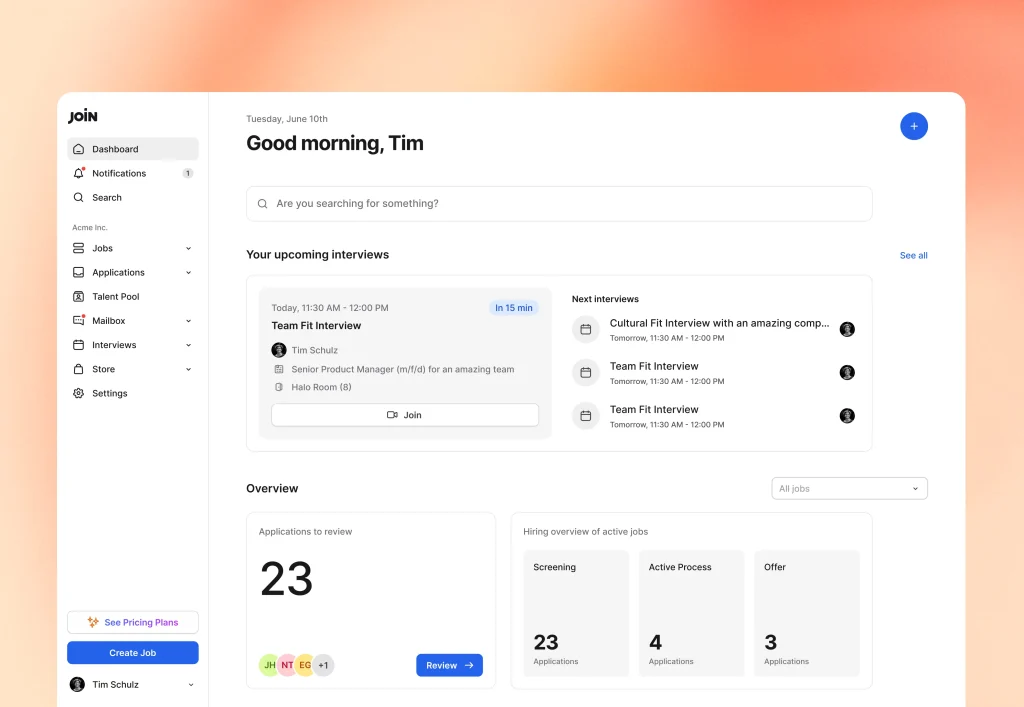
A simple pipeline fixes this. Tools like JOIN Applicant Tracking System let you see exactly where every candidate sits at a glance, post to multiple job boards in one go, and keep your whole team aligned without the back-and-forth. Less admin, more time actually talking to people.
Communicate with candidates at every stage
Communication shapes the candidate experience throughout your hiring process. Send a quick acknowledgement when you receive an application. When you reject someone, send a brief, kind note. When you’re moving to an interview, tell them what to expect. Candidates remember this treatment. Even those you don’t hire become advocates if you treat them well.
Run structured interviews with consistent notes
For interviews, schedule them at consistent times, ideally with at least two people present. One person can lead the conversation while the other takes notes. Use prepared interview questions that are the same for every candidate to ensure fair comparison. Research from SHRM shows that structured interviews predict job performance far better than unstructured conversations. Record your notes immediately after each interview, as details fade fast. Consistency matters more than perfection.
Debrief and compare candidates fairly
Between interviews, debrief briefly. Did this person answer your key questions? Did they seem excited about the role? Would they work well with the team? Document these observations in your tracker so you can compare candidates fairly a week or two later. Having notes prevents memory bias and makes discussions more productive.
The entire hiring process, from opening a role to extending an offer, typically takes 3–4 weeks for small teams. Anything much longer risks losing candidates to other offers.
How JOIN simplifies hiring for teams without HR
Managing hiring without dedicated HR support becomes much easier with the right recruiting software. Rather than juggling spreadsheets and emails, a structured tool keeps everything in one place: job postings, applications, candidate profiles, interview notes, and feedback. This eliminates the friction of multiple tools and keeps your hiring consistent.
With JOIN’s recruiting software, small teams can manage job ads, track candidates, and collaborate on hiring decisions in one place. This makes hiring without an HR department faster, clearer, and more consistent. Every team member sees where candidates are in the pipeline, what’s been discussed, and what happens next, removing the guesswork that often comes from incomplete communication or scattered notes.
5 Tips to Hire Effectively Without an HR Department
- Define clear success criteria for every role before you start recruiting: this becomes your filter for every decision.
- Use a simple tracking system to keep all candidates and feedback in one place.
- Conduct structured interviews with the same questions for every candidate to ensure fair comparison.
- Communicate regularly with candidates at each stage: transparency builds trust and reinforces your employer brand.
- Involve multiple people in final decisions and discuss evidence rather than relying on a single interviewer’s impression.
Frequently Asked Questions
Most effective hiring processes take 3–4 weeks from opening a role to extending an offer. Longer timelines risk losing candidates to competing offers, while rushing leads to poor hiring decisions. A structured process with clear timelines helps your team stay organised and move at the right pace.
Review your job description for clarity and check whether your compensation is competitive for your market. Expand your recruitment channels by asking your team for referrals, posting on industry-specific boards, and tapping your professional network directly.
You can screen applications and references alone, but an interview is essential to assess communication, problem-solving, and team fit. It’s the best way to go beyond what’s written on a resume.
Use consistent criteria for all candidates, take notes during interviews, and involve multiple people in decisions. Structured hiring processes naturally reduce bias compared to informal gut-check methods because they focus on evidence rather than first impressions.
Keep records of why you selected each candidate, basic interview notes, and any key conversations about hiring decisions. This protects you legally and helps you reflect on what worked well and what to improve next time.
Ghosting candidates damages your reputation, and in a small market, people talk.
A simple two-line template is all you need: thank them for their time, let them know you are moving forward with other candidates, and where possible name one specific strength. It takes thirty seconds and leaves a lasting impression.
The rule is simple: treat every candidate the way you would want to be treated if the situation were reversed.

Alana Barbosa
Alana is a creative member of JOIN’s Marketing team. As a Junior Marketing Specialist, she focuses on crafting engaging and insightful content that supports recruiters and job seekers alike. With a strong interest in storytelling and talent acquisition topics, Alana produces articles that inform, inspire, and reflect JOIN’s mission to make hiring smarter.